Made Here, Known Everywhere: The New York Artisans Redefining What American Craft Looks Like
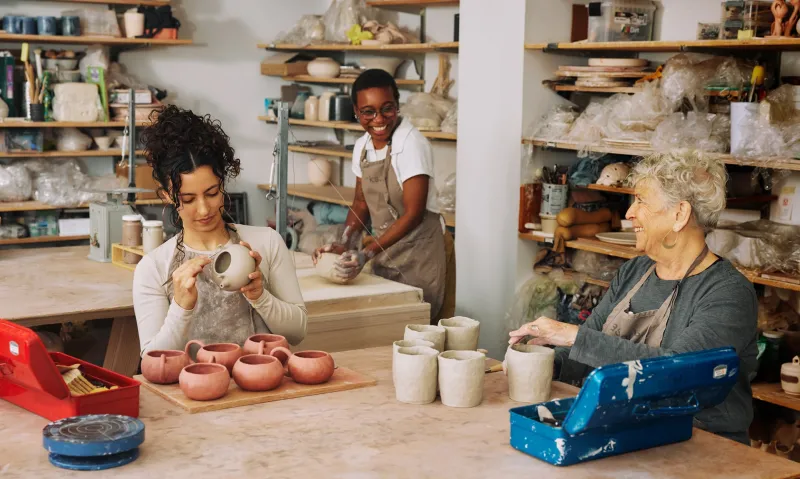
Photo: Brooklyn artisan workshop ceramics handmade craft independent maker studio, via gasworksnyc.com
There is a particular kind of object that announces itself differently from everything else on a shelf. You pick it up and something registers — a weight, a texture, a decision made in the making of it that no algorithm specified and no overseas factory replicated. You are holding, unmistakably, something that a person made.
In New York City, a generation of independent makers is producing exactly these objects — and, in doing so, building something larger than their individual studios. They are constructing a new understanding of what American craft can mean in the twenty-first century: not nostalgic, not precious, not inaccessible, but deeply considered, locally rooted, and increasingly national in its reach.
From ceramic studios in Greenpoint to textile workshops in Red Hook, from leatherworkers operating out of Gowanus to furniture makers in the Bronx, the city's artisan community is demonstrating that the values of local production and authentic materials are not constraints on ambition. They are, increasingly, the source of it.
The Workshop as Brand Identity
For many of New York's emerging makers, the physical space of production is not incidental to the brand — it is the brand. The studio is the story. The neighborhood is the narrative.
Consider the small ceramics studios that have proliferated across Brooklyn over the past decade, many of them operating with a direct-to-consumer model that invites customers to witness, and in some cases participate in, the making process. These are not manufacturers with a lifestyle veneer. They are working studios that happen to sell what they make, and the distinction matters enormously to their customers.
This transparency — the willingness to show the wheel, the kiln, the rough edges before the glaze — has become a form of brand equity that no marketing budget can manufacture. It communicates something essential: that the object you are acquiring has a specific origin, a specific pair of hands, a specific neighborhood. In an era of frictionless global supply chains, that specificity is increasingly rare, and increasingly valued.
Materials With a Story
The makers building lasting reputations in New York's artisan community share a common preoccupation: material sourcing as a design decision, not merely a procurement necessity.
One Greenpoint-based textile designer, who produces limited-run woven goods using American-grown fibers, describes her sourcing process as the first creative act of any new collection. "What the material is and where it comes from shapes everything that follows," she explains. "I am not decorating a surface. I am working with something that already has a history."
This philosophy manifests in the objects themselves. Cutting boards made from sustainably harvested New York State hardwoods. Candles poured with domestic soy wax and scented with botanicals grown in Hudson Valley gardens. Leather goods produced with hides sourced from American ranches, tanned using traditional methods at a family-owned facility in the Midwest. Each of these decisions adds cost and complexity. Each of them also adds meaning — and meaning, it turns out, is what the national market is increasingly willing to pay for.
The Community as Infrastructure
What distinguishes New York's maker community from isolated artisan enterprises in other cities is the density of its ecosystem. The city's creative neighborhoods function as informal incubators, where leatherworkers share sourcing contacts with jewelers, ceramicists advise furniture makers on kiln logistics, and a single conversation at a Red Hook open studio can result in a collaboration that reaches a national audience within a year.
This network is not accidental. It has been cultivated through markets, maker collectives, shared workshop spaces, and the particular culture of creative mutual support that has long characterized New York's arts communities. The result is a rising-tide dynamic: when one maker gains national recognition, they frequently bring others with them, through mentions, collaborations, and the credibility that proximity to quality confers.
Several of the city's most prominent independent makers speak of this community not as a competitive landscape but as a collective resource — one that has allowed small studios operating on modest budgets to achieve distribution, press coverage, and brand recognition that would have been unimaginable for independent makers in a previous era.
Scaling Without Losing the Thread
The central challenge facing New York's most successful emerging makers is one of growth: how to expand production and reach without surrendering the qualities — the handwork, the material integrity, the genuine local rootedness — that created demand in the first place.
The makers navigating this most successfully tend to do so through deliberate constraint. Rather than scaling production to meet every order, they scale their audience while maintaining production limits, creating waiting lists and seasonal releases that protect quality while building anticipation. Rather than moving production offshore when costs increase, they find efficiencies within their existing model — better tooling, more efficient studio layouts, collaborative purchasing with neighboring makers.
One Brooklyn-based furniture designer, whose work now appears in homes across the country, describes his approach with characteristic directness: "The moment I stop being able to tell you exactly where every piece of wood in this table came from, I have made a different product. I am not interested in making a different product."
This kind of principled restraint is not simply an ethical position. It is a market position — and an increasingly powerful one.
How to Support the Makers Doing This Work
For those who wish to engage meaningfully with New York's independent maker community — whether as customers, collectors, or simply as people who care about where things come from — a few principles bear repeating.
Buy directly when possible. The maker's own website or studio sale is not merely more convenient for the maker; it is also the context in which their work is best understood, most accurately represented, and most fully valued. The object arrives with its story intact.
Ask questions. The best makers welcome inquiry about materials, process, and provenance. A maker who cannot or will not answer these questions is telling you something important.
Consider the full cost. A handmade ceramic bowl from a Brooklyn studio will cost more than a mass-produced equivalent. It will also outlast it, carry meaning that the mass-produced version cannot, and support a form of local production that deserves to persist. The comparison is not, in any honest sense, a comparison between equivalent objects.
And perhaps most importantly: pay attention to what is being made in your own city. The movement being built in New York's workshops is not unique to New York. It is happening in Chicago, in New Orleans, in Portland, in Philadelphia — wherever makers with genuine skill and genuine values have found a neighborhood willing to sustain them. The work of supporting it begins with the decision to look.