Between Two Worlds: How New York's Most Thoughtful Dressers Are Transforming the Daily Commute Into a Ritual of Becoming
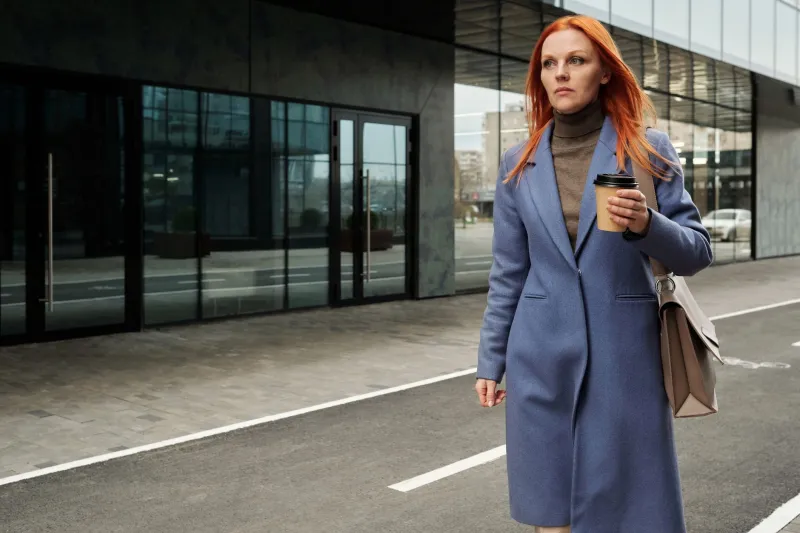
There is a particular kind of intelligence that New York has always demanded of its inhabitants — the ability to move fluidly between states, to be one thing in one room and another entirely in the next. The city's compressed geography has long made that skill essential. What is changing, quietly and meaningfully, is the degree to which a certain cohort of New Yorkers has begun to treat the passage between those rooms not as dead time, but as sacred time.
The daily commute — whether underground on the A train, astride a bicycle along the Hudson River Greenway, or on foot through the particular morning light of the West Village — is being reclaimed. Not as a productivity window for catching up on emails, but as a liminal corridor: a deliberately unhurried transition between the self who lives and the self who works.
The Psychological Architecture of Getting There
The concept of a psychological boundary between home and professional life is well established in behavioral research. What is less discussed is the role that clothing and personal presentation play in constructing that boundary with intention. For many New Yorkers, the act of dressing is no longer confined to the bedroom mirror. It extends outward, into the commute itself.
Consider the woman who boards the 1 train at 72nd Street each morning in a precisely belted wool coat, her tote chosen not for its capacity but for the way its structure holds its shape against the press of a crowded car. Or the man who walks the forty blocks from his apartment in Cobble Hill to his firm in Lower Manhattan, adjusting his pace and his posture as deliberately as he adjusted his collar before leaving the house. These are not accidents of habit. They are architectured transitions.
Dress, in this context, functions as a kind of portable threshold. The coat buttoned at the door. The scarf wound with care. The shoes that announce, with each step on pavement, that a different version of oneself is now present.
The Commute as Wardrobe Laboratory
New York's commuting conditions are famously unforgiving — a fact that has long shaped the city's relationship with functional dressing. What is notable now is not the functionality itself, but the sophistication with which it is being considered. The most intentional commuters are asking not merely what will hold up, but what will hold meaning.
Fabrics that move with the body rather than against it. Footwear that does not announce its compromise. Outerwear that transitions from the humidity of a subway platform to the chill of an open avenue without losing its composure. These are the quiet criteria of a wardrobe built for the city's actual rhythms, as opposed to the idealized rhythms of a fashion editorial.
But the wardrobe laboratory of the commute is also a place of subtler experimentation. The deliberate choice of a particular pin on a lapel. The scarf that serves as both insulation and punctuation. The bag whose weight, when properly distributed, becomes a kind of ballast for the day ahead. Each element is tested against the specific conditions of the journey, refined over seasons, until it becomes as reliable as the route itself.
Grooming as Punctuation
For many in this community, the rituals extend beyond clothing into grooming — though grooming, here, is understood in its broadest and most considered sense. It is less about vanity and more about the deliberate act of finishing. The application of a fragrance before stepping outside. The final pass of a brush through hair before descending into the subway. The moment of stillness at the front door before the lock turns.
These small ceremonies function as full stops between chapters. They signal, to the self as much as to anyone else, that a transition is underway. Psychologists who study the concept of "role transitions" have noted that physical rituals — particularly those involving the body and its presentation — are among the most effective tools for mentally shifting between different social contexts. New York's most intentional commuters appear to have arrived at this understanding through practice rather than theory.
Redefining Power Dressing for the Present Moment
The phrase "power dressing" carries a great deal of historical baggage — shoulder pads and signal colors, the visual vocabulary of an era when professional authority had to be broadcast loudly to be heard at all. The power dressing of the current moment is something altogether quieter, and arguably more sophisticated.
It is the power of coherence: a person who appears to have made decisions, and to have made them with care. In a professional landscape increasingly saturated with the casual and the unconsidered, the deliberate dresser stands apart not through volume or ostentation, but through the visible evidence of intention. The commute, traversed with that same intentionality, becomes an extension of this philosophy.
There is something deeply New York about this particular approach to presence. The city has always rewarded those who can move through its density without being dissolved by it — who can maintain a sense of self against the extraordinary pressure of the collective. The intentional commute is, in this sense, a very old New York practice in a newly articulate form.
The Slower Walk
Perhaps the most telling expression of this shift is the deliberate slowing of pace. In a city that has long equated speed with seriousness, the choice to walk more slowly, to allow the commute to breathe, represents a quiet form of resistance. It is a refusal to treat the journey as waste, as something to be compressed and discarded on the way to what actually matters.
For those who have made this choice, the commute has become something genuinely valuable in its own right — a daily practice of presence that neither the home nor the office can quite provide. The city, observed at a considered pace, offers a different quality of attention. The particular amber of early light on a brownstone facade. The smell of coffee from a corner cart. The sound of the city assembling itself for another day.
Dressed well, moving deliberately, carrying only what is necessary — this is the commuter as a kind of urban contemplative. The destination will arrive. But the journey, it turns out, was always worth the attention.