After Forty, Everything Changes: How New York Women Are Finally Dressing for Themselves
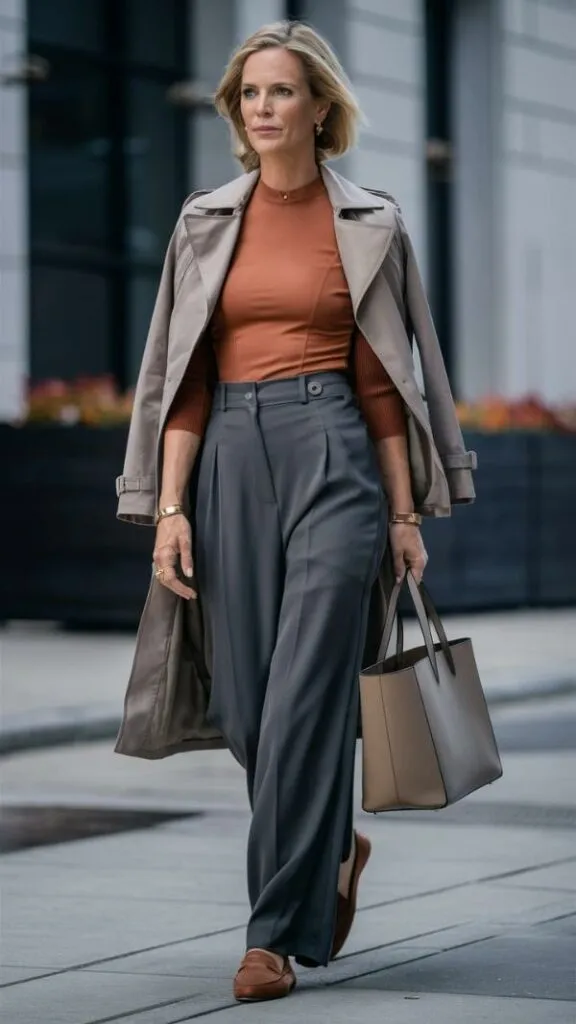
Photo: elegant mature woman New York city stylish minimalist outfit over 40, via www.fashionacy.com
There is a particular kind of clarity that arrives, often quietly, somewhere in the fourth decade of a woman's life. The noise that once dictated what to wear—the runway photographs, the department store mannequins, the silent social pressure of being seen in the right thing at the right moment—begins to recede. What remains is something far more interesting: a woman who knows precisely who she is and, perhaps for the first time, intends to dress accordingly.
In New York, this shift is unfolding with uncommon sophistication. Across the boroughs, in the studios of Tribeca and the brownstones of Brooklyn Heights, in the Upper West Side apartments of editors and architects and entrepreneurs, women over forty are undertaking a quiet but radical reinvention of their wardrobes. They are not chasing youth. They are not surrendering to invisibility. They are doing something altogether more compelling: they are editing.
The Great Unraveling
For many women, the process begins with a closet that no longer makes sense. Decades of accumulation—impulse purchases, work uniforms, pieces bought to fit a version of themselves that has long since evolved—confront them on an otherwise ordinary Tuesday morning. The realization is swift and, for most, liberating.
"I looked at what I owned and realized I was still dressing for an audience I no longer cared about," says a fifty-two-year-old gallery director who requested anonymity. "There were pieces I'd bought because they were fashionable, pieces I'd bought because they were expected for my role, and almost nothing I'd bought purely because I loved it. That was the wake-up call."
This experience is not unique. Stylists and fashion consultants working with clients in this demographic describe a common pattern: the first serious wardrobe overhaul of a woman's adult life tends to happen not in her twenties, when she is still experimenting, but in her forties and fifties, when she finally has both the means and the self-knowledge to do it properly.
Quality as the New Currency
What replaces the discarded accumulation is, by nearly every account, far less in quantity and far higher in caliber. The women rewriting their wardrobes after forty are gravitating toward pieces that reward close attention—tailoring that fits the actual body rather than an idealized one, fabrics that improve with age, silhouettes that have remained relevant across decades rather than seasons.
Several New York-based brands have taken notice. Labels such as Cuyan, Argent, and the quietly beloved M.M. LaFleur have built loyal followings among women in midlife precisely because they offer something the broader fashion industry has historically withheld from this demographic: clothing that is simultaneously elegant, practical, and designed with adult proportions in mind. Meanwhile, the secondary market for heritage pieces—vintage Armani blazers, archival Donna Karan, early-era Calvin Klein—has surged as women seek the kind of enduring construction that contemporary fast fashion simply cannot replicate.
"I spent my thirties buying things I thought I should want," says a forty-seven-year-old attorney who now describes her wardrobe as "ruthlessly minimal." "Now I only buy things I actually want. The irony is that I spend more per piece and dramatically less overall."
The Psychology of Dressing for Authenticity
Fashion psychologists and image consultants have long observed that the relationship between clothing and identity shifts meaningfully in midlife. Where younger women often use dress as a means of signaling aspiration—projecting a self they are working toward—women in their forties and beyond tend to use it as a means of confirmation. The wardrobe becomes a mirror of who they already are rather than a blueprint for who they hope to become.
This distinction carries real consequences for how they shop. Impulse purchases become rare. The urge to follow trends diminishes not because these women have stopped caring about aesthetics—if anything, their aesthetic sensibility has deepened—but because trends, by definition, belong to a collective moment rather than a particular self. The woman who has spent four decades becoming exactly who she is has little interest in dressing like everyone else.
"There's a freedom in it that I didn't anticipate," says a fifty-year-old creative director who maintains a wardrobe of fewer than forty pieces. "When you stop trying to be fashionable and start trying to be yourself, getting dressed becomes genuinely pleasurable. It used to be stressful. Now it's one of the best parts of my morning."
New York as a Laboratory for Reinvention
It is worth noting that this particular evolution is happening with distinctive intensity in New York. The city has always been a place where self-invention is not only permitted but expected, where the street is a stage and personal style a legitimate form of communication. For women in midlife, that cultural permission is enormously enabling.
New York also offers unparalleled access to the resources this kind of wardrobe requires. Independent tailors in Midtown and the Garment District can alter vintage finds to perfection. Consignment shops in the West Village and on the Upper East Side carry archival pieces at prices that reward patience and discernment. Personal stylists who specialize in working with women over forty—a specialty that has grown considerably in recent years—offer the kind of focused guidance that generic fashion advice cannot provide.
The result is a cohort of women whose wardrobes reflect not a single trend or season but an accumulated, deeply personal aesthetic that could belong to no one else. A charcoal wool blazer worn over a silk camisole. A perfectly proportioned trouser in a fabric that moves beautifully. A single statement coat in a color chosen not because it is trending but because it is, simply, theirs.
The Wardrobe as Self-Authorship
Perhaps what is most striking about this shift is what it reveals about the broader project of midlife identity. Dressing well after forty is not, for these women, a vanity project. It is an act of authorship—a daily, tangible expression of the values, preferences, and hard-won self-knowledge that the preceding decades have made possible.
The closet, stripped of everything that no longer fits or no longer resonates, becomes a kind of autobiography. Every remaining piece has been chosen with intention, kept with purpose, and worn with the quiet confidence of someone who no longer needs external validation to feel well-dressed.
In a city that has always celebrated reinvention, this may be the most New York story of all: women who have spent a lifetime learning the rules, mastering them thoroughly, and then setting them aside in favor of something far more interesting—their own.
The second act, it turns out, has the best wardrobe.