The Considered Pause: What New York's Most Deliberate Dressers Know About Waiting Before They Buy
There is a particular kind of discipline that does not announce itself. It does not arrive with a manifesto or a capsule wardrobe challenge shared across social media. It lives, instead, in the quiet moment between seeing something beautiful and reaching for a credit card—and choosing, deliberately, to do nothing at all.
Across New York, a growing number of dressers have made this pause the centerpiece of how they relate to clothing. Not out of austerity, and not because they have lost their appetite for beautiful things, but because they have come to understand that desire, left to breathe, becomes something far more useful than impulse ever could.
The Architecture of a Wishlist
For Margaux Delacroix, a textile consultant based in Carroll Gardens, the practice began with a single notebook. "I started writing things down instead of buying them," she explains. "A coat I saw in a window on Atlantic Avenue. A particular shade of camel I kept returning to mentally. A pair of boots I wasn't sure I needed or simply admired."
The notebook, she discovered, became a kind of archive of her own taste—and a surprisingly effective filter. "After thirty days, I would look back at what I'd written. Some things I still wanted urgently. Most I'd forgotten entirely. That forgetting told me everything."
This strategy—sometimes called a wishlist practice, sometimes simply a waiting period—has become a cornerstone habit among New York's most considered consumers. Stylists, editors, and everyday professionals alike describe variations of the same ritual: the deliberate insertion of time between the moment of wanting and the moment of deciding.
The underlying logic is straightforward. Desire, in its immediate form, is largely physiological. It responds to novelty, to scarcity cues, to the particular lighting of a well-merchandised boutique. Given a week, or a month, it either deepens into something genuine or dissolves into the ambient noise of modern retail.
What Waiting Actually Teaches
Patience, in this context, is not passive. The women and men who practice it describe an active process of interrogation—a series of questions they have learned to ask themselves in the interval between wanting and acquiring.
Does this fill a gap I have genuinely identified, or does it create a gap I didn't know I had? Does it work with what already hangs in my closet, or does it require additional purchases to function? Would I still want this if it were not on sale, not newly arrived, not sitting in a beautiful shop on a Tuesday afternoon when the light was just right?
"The sale is the most dangerous moment," says Oliver Vance, a menswear stylist who works with clients across the Upper West Side and Tribeca. "Because it adds urgency to desire, and urgency is the enemy of clarity. I tell clients: if you wouldn't want it at full price, the discount isn't saving you money. It's costing you closet space and peace of mind."
Vance has built a consultation practice around what he calls "wardrobe archaeology"—the process of understanding what clients already own before helping them identify what they actually need. The waiting practice, he argues, is simply archaeology applied to future purchases. "You're excavating your own preferences before the transaction happens rather than after."
The Waiting List as a Different Kind of Luxury
There is a certain irony in the fact that some of fashion's most coveted objects have always required waiting. The made-to-order coat. The bespoke shoe. The small-batch bag from an artisan whose production schedule is dictated by craft rather than commerce. In these cases, the wait was never a bug—it was a feature, a signal that what you were acquiring was worth the patience it demanded.
The slow-closet movement, as some practitioners informally call it, borrows from this logic and applies it universally. Every potential purchase, regardless of price point or provenance, is placed on an informal waiting list. Time becomes the great equalizer—the same thirty-day rule applies to a cashmere sweater and a pair of earrings spotted at a weekend market in Brooklyn.
For Simone Park, a writer and longtime Prospect Heights resident, this approach transformed not just her wardrobe but her sense of self within it. "I used to feel like my closet was always slightly wrong—like I was always one purchase away from having it right. The waiting practice showed me that feeling was manufactured. It was the shopping itself that was creating the sense of lack."
Her closet today contains fewer pieces than it did five years ago, but each one, she says, was wanted long enough to be trusted. "There's no regret in there. Nothing that arrived in a moment of weakness. That changes how I get dressed in the morning in ways I didn't anticipate."
The Practical Mechanics
For those new to the practice, the methods vary but the principles converge. Some practitioners use dedicated apps to screenshot and catalog items they're considering, revisiting the folder at fixed intervals. Others maintain physical notebooks or pinboards—analog systems that require a small act of intention to maintain and therefore carry more psychological weight than a saved Instagram post.
The waiting period itself ranges from two weeks to three months, depending on the practitioner and the category of purchase. Trend-driven pieces are often held longest; if the appeal has not survived a season, it was likely borrowed from the cultural moment rather than rooted in personal taste. Investment pieces—outerwear, footwear, tailoring—are sometimes held shorter, because the decision-making process for them is more deliberate from the outset.
What nearly every practitioner agrees on is the value of articulating, in words, why a specific piece appeals. Vague desire—"I just love it"—is treated with suspicion. Specific desire—"I need a structured blazer in a neutral that works over both dresses and denim, and this particular cut addresses the shoulder fit issues I've had with every other option"—is taken seriously.
A Different Relationship With Shops
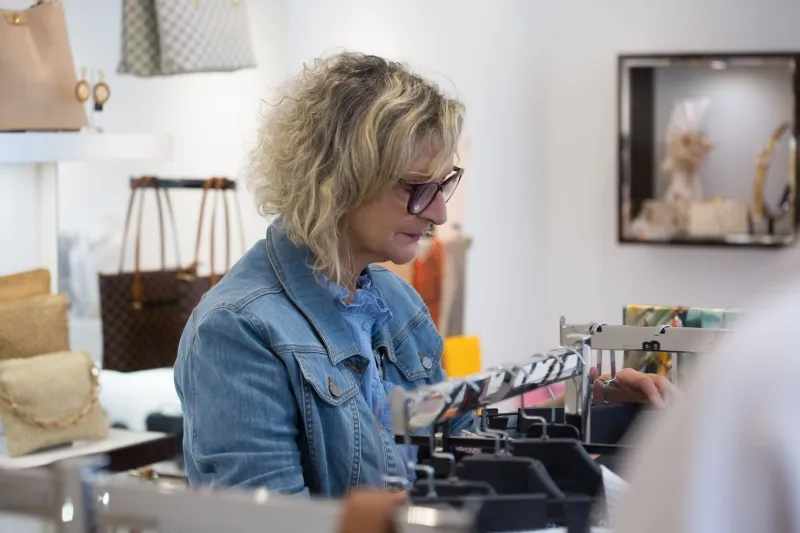
Perhaps the most unexpected consequence of the slow-closet practice is what it does to the experience of shopping itself. When acquisition is no longer the default outcome of browsing, browsing becomes something else entirely: a form of research, of aesthetic education, of pleasure that does not require a transaction to feel complete.
"I go into shops differently now," says Delacroix. "I'm genuinely curious. I touch things, I ask questions, I learn about how something is made. I'm not in a hurry to own it. And sometimes that means I leave without buying anything, and sometimes it means I come back three weeks later and buy something I've thought about carefully. Either way, I feel like myself."
In a city that has long equated speed with sophistication, this is a quietly radical position. The most considered dressers in New York have discovered that the truest luxury available to them is not the next beautiful thing—it is the clarity to know, with certainty, that they genuinely want it.