Quiet Confidence: How New York's Restrained Aesthetic Rewrote the American Wardrobe
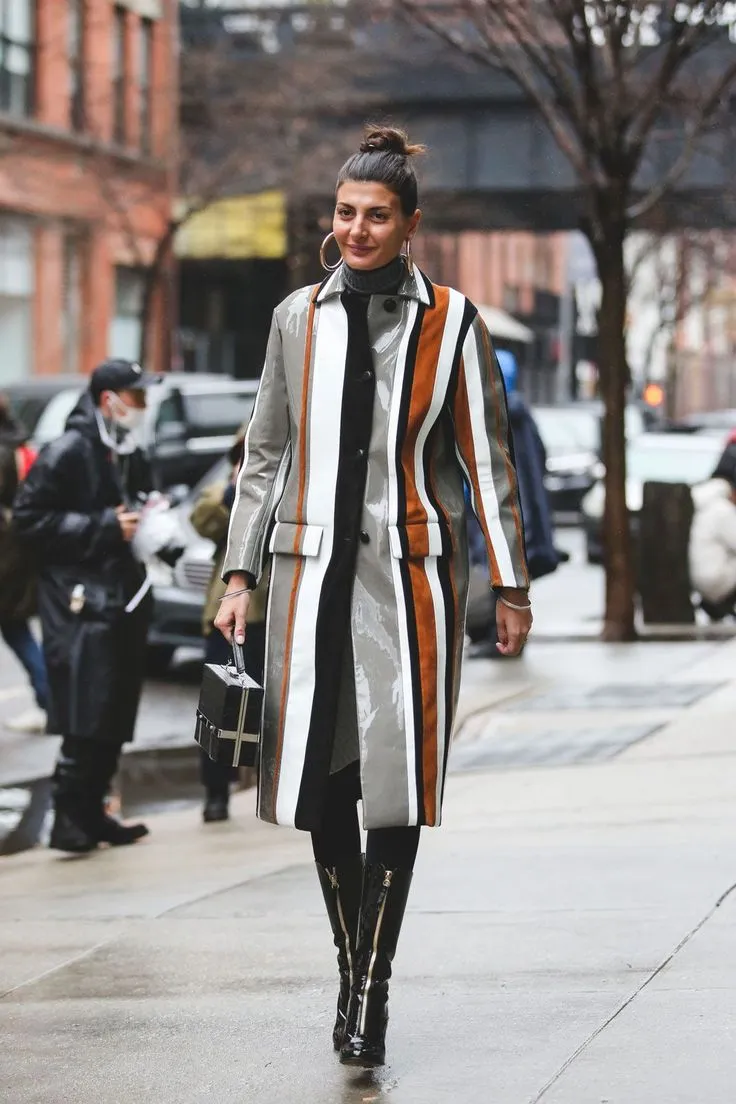
Photo: New York City street style minimalist layering neutral tones wool coat autumn, via i.pinimg.com
There is a particular kind of elegance native to the streets of New York City. It does not announce itself. It does not compete for attention. It moves through a crowded subway car and a candlelit dinner with equal ease, asking nothing of its audience except a second, more careful look. This is the aesthetic that built a city's reputation—and quietly, methodically, reshaped the way Americans across the country think about getting dressed.
The minimalist layering tradition that defines so much of New York's street style did not emerge from a single runway or a single season. It evolved organically, shaped by the particular pressures of urban life: the need to transition between wildly different environments in a single day, the premium placed on closet space, and a cultural suspicion of anything that tries too hard. What emerged is something far more sophisticated than simple restraint. It is, at its core, a philosophy of intention.
The Psychology of Less
To understand why New York's approach to dressing has proven so enduringly influential, one must first understand what it is actually communicating. Minimalism in fashion is frequently misread as austerity—a kind of aesthetic fasting. In reality, the New York sensibility is something richer and more deliberate. It is the confidence to let fabric speak, to allow a single well-cut coat to carry the full weight of an outfit.
Stylist and longtime Manhattan resident Celeste Harmon, who has dressed clients ranging from Wall Street executives to Brooklyn-based artists, describes the philosophy this way: "New Yorkers don't dress to be seen. They dress to move. The city has a pace, and your clothes have to keep up. What you find is that the people who look the most put-together here are almost never wearing the most things. They've edited ruthlessly, and that editing is the statement."
This psychological dimension—the idea that curation itself is a form of expression—has resonated far beyond the five boroughs. In cities from Chicago to Los Angeles to Austin, a growing cohort of style-conscious consumers has adopted the same framework: fewer pieces, better quality, and a palette that prioritizes coherence over novelty.
The Architecture of a New York Outfit
At the structural level, the New York layering approach operates on a set of principles that are both practical and quietly aesthetic. The foundation is invariably a quality basic—a fitted crewneck in merino wool, a crisp white Oxford shirt, a well-proportioned T-shirt in a heavyweight cotton. These are not afterthoughts. They are the load-bearing walls of the entire construction.
Over this foundation, the New York dresser builds thoughtfully. A tailored blazer in a neutral—camel, charcoal, navy, or the ubiquitous off-white—adds structure without formality. A longline coat, arguably the single most important investment in the New York wardrobe, provides the outer layer that the city's winters demand and that the city's visual culture celebrates. Leather accessories—a slim belt, a structured tote, a pair of clean ankle boots—function as punctuation: precise, considered, and never excessive.
The palette, crucially, remains controlled. This is not a rule born of timidity but of sophistication. When every element of an outfit exists within a cohesive tonal range, the eye is drawn to proportion, texture, and silhouette—the elements that actually distinguish exceptional dressing from merely adequate dressing.
From Manhattan to Main Street
The national adoption of this aesthetic has been both gradual and, in recent years, accelerating. The rise of so-called "quiet luxury" as a mainstream cultural conversation—fueled in part by prestige television, in part by a broader post-pandemic reassessment of consumption—gave language to something New York had been practicing for decades. Suddenly, the understated cashmere pullover and the perfectly proportioned wide-leg trouser were not just practical choices. They were aspirational ones.
Designer Marcus Levi, whose small-batch menswear label operates out of a studio in the West Village, has watched this shift with a mixture of satisfaction and amusement. "There's a whole generation of people in the Midwest, in the South, who are shopping the way New Yorkers shop—thinking about cost-per-wear, thinking about what works together, not just what looks exciting on a hanger. That's a real change. That's New York's influence working its way through the culture."
Retail data supports this observation. Sales of what the industry terms "investment basics"—premium-quality wardrobe staples in neutral colorways—have grown consistently across major U.S. markets over the past three years, with the sharpest increases recorded outside of traditional fashion capitals.
Building Your Own Curated Wardrobe
For those looking to adopt this approach, the entry point is not a shopping list. It is an audit. The first and most important step is to assess what you already own with genuine honesty—identifying which pieces are truly versatile, which serve a single narrow purpose, and which have not been worn in the past year. The New York wardrobe is defined less by what it contains than by what it excludes.
From that edited foundation, the investment priorities become clear. A coat is worth spending on—it is the first and last thing the world sees, and a beautifully constructed wool overcoat will outlast a dozen fast-fashion alternatives. Leather goods reward investment equally: a well-made bag or pair of boots improves with age in a way that synthetic alternatives simply cannot replicate.
Texture becomes the primary tool of visual interest once the palette is controlled. The interplay of a brushed flannel trouser against a smooth ribbed knit, or a waxed canvas jacket over a crisp poplin shirt, provides the kind of quiet complexity that rewards attention without demanding it.
Finally, fit remains the non-negotiable variable. The New York aesthetic is not about oversized or slim—it is about correct. A coat that hits at precisely the right point on the thigh, a trouser with a break that falls exactly so: these are the details that separate a curated wardrobe from merely an expensive one. Tailoring, long considered a luxury, is perhaps better understood as the final, essential investment.
The Enduring Relevance of Restraint
Fashion, by its nature, is cyclical. Maximalism will always return, as it periodically does, to challenge the reign of restraint. But the New York minimalist tradition has demonstrated a durability that transcends trend cycles, precisely because it is grounded in something more fundamental than aesthetics. It is grounded in a relationship with clothing that is thoughtful, sustainable, and deeply personal.
To dress in this way is to make a series of quiet commitments: to quality over quantity, to longevity over novelty, to the considered over the impulsive. These are values that resonate across geography and generation. They are, in the end, less about New York than about a certain way of moving through the world—with intention, with confidence, and with very little excess.
At Bird & Branch NYC, we believe that the most enduring style is always the most honest. It asks only that you know yourself well enough to dress accordingly.